


Frequently Asked Questions
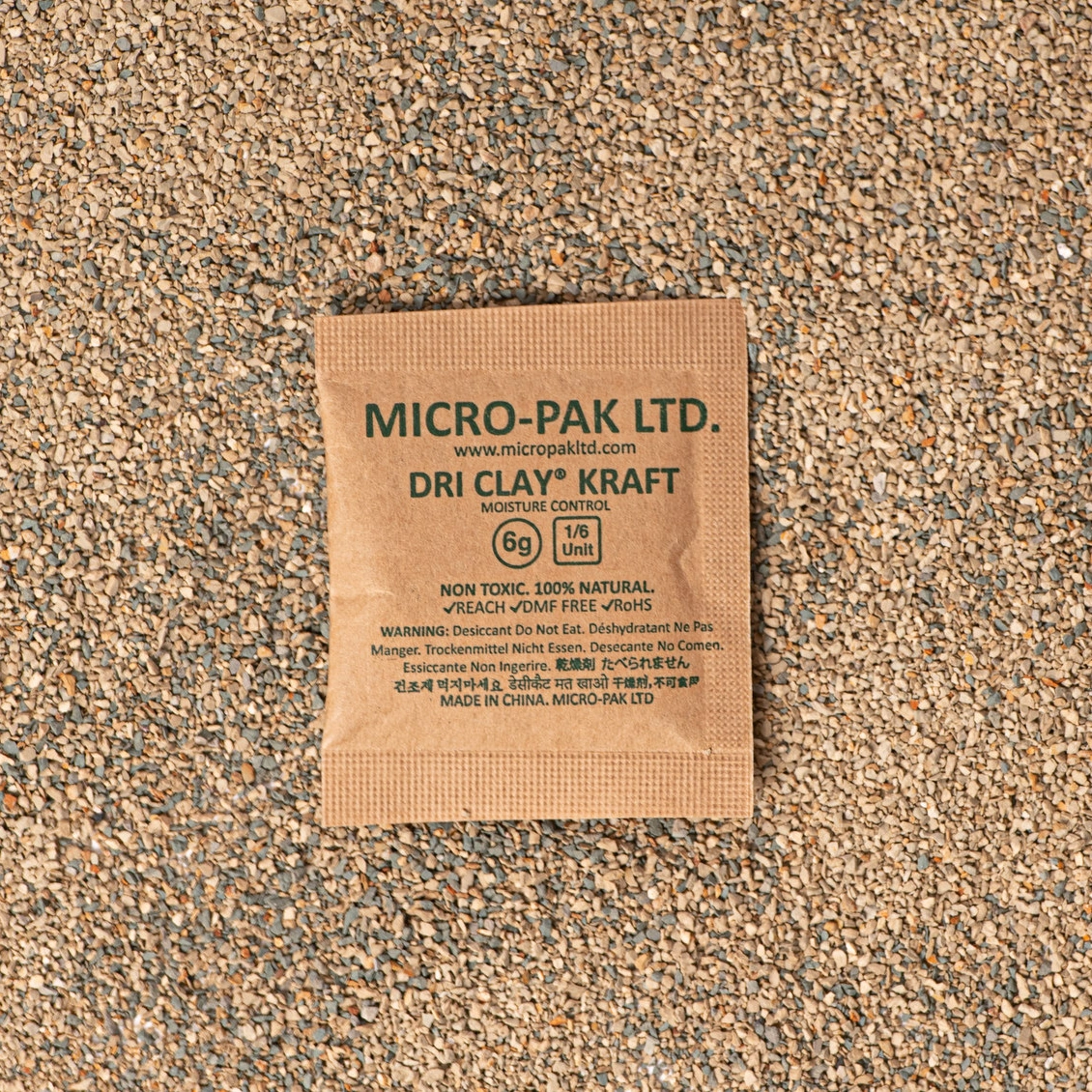
Dri Clay® Kraft
What is Dri Clay® Kraft?
Dri Clay® Kraft is a plastic-free desiccant made from natural bentonite clay and packaged in FSC-certified, biodegradable Kraft paper. It is designed to absorb moisture inside packaging and protect products from humidity-related damage.
The product is Plastic Free certified and presents no risk of leakage, corrosion, or release of harmful substances.
What is Dri Clay® used for?
Moisture can damage many products during transport and storage, causing mold growth, corrosion, rust, or electronic malfunctions.
Dri Clay® adsorbs moisture from the air inside packaging to preserve product quality and extend shelf life.
It is suitable for a wide range of applications, including textiles, leather, metal components, electronics, food products, pharmaceuticals, and medical devices.
What is Dri Clay® made of?
Dri Clay® is composed of 100% bentonite, a natural mineral with a high adsorption capacity.
It meets strict technical requirements, including recognized industrial and military specifications.
What is the difference between Dri Clay® and silica gel?
Dri Clay® présente plusieurs avantages majeurs :
- Sustainability: natural, plastic-free, biodegradable product with low environmental impact.
- Performance: enables lower humidity levels to be achieved in sealed packaging.
- Regulatory safety: REACH-exempt, DMF-free, compliant with European regulations, unlike some silica gels that may contain substances of concern.
What is the difference between adsorption and absorption?
Adsorption refers to the binding of water vapor to the surface of the clay without any change in its shape or texture.
Absorption involves the transformation of the desiccant into a liquid solution.
Dri Clay® works through adsorption, ensuring complete stability and eliminating any risk of leakage.
How much Dri Clay® should be used?
Dri Clay® is available in several formats (2 g, 6 g, 17 g, 33 g, and 66 g).n
The required quantity depends on the packaging volume and the product’s sensitivity to humidity. Proper sizing is recommended to ensure optimal protection.
Does usage vary depending on the season?
No. Usage recommendations apply year-round, as supply chains continuously pass through high-humidity environments.
How long is Dri Clay® effective?
Dri Clay® can adsorb approximately 30–40% of its own weight in water vapor and remains active until fully saturated.
Do the sachets fill with water?
No. Even at saturation, Dri Clay® remains dry, with no change in shape or texture, and poses no risk of leakage or corrosion.
What is the shelf life and how should the product be stored?
Dri Clay® can be stored for up to two years in its original, unopened packaging.
It should be kept in a dry place, protected from heat and light. Unused sachets should be resealed promptly and used as soon as possible.
Is Dri Clay® reusable?
No. Dri Clay® is designed for single use only.
Is Dri Clay® safe?
Yes. Dri Clay® is non-toxic, environmentally safe, REACH-exempt, DMF-free, RoHS compliant, and approved for food and pharmaceutical contact.
It is packaged in FSC-certified, biodegradable material
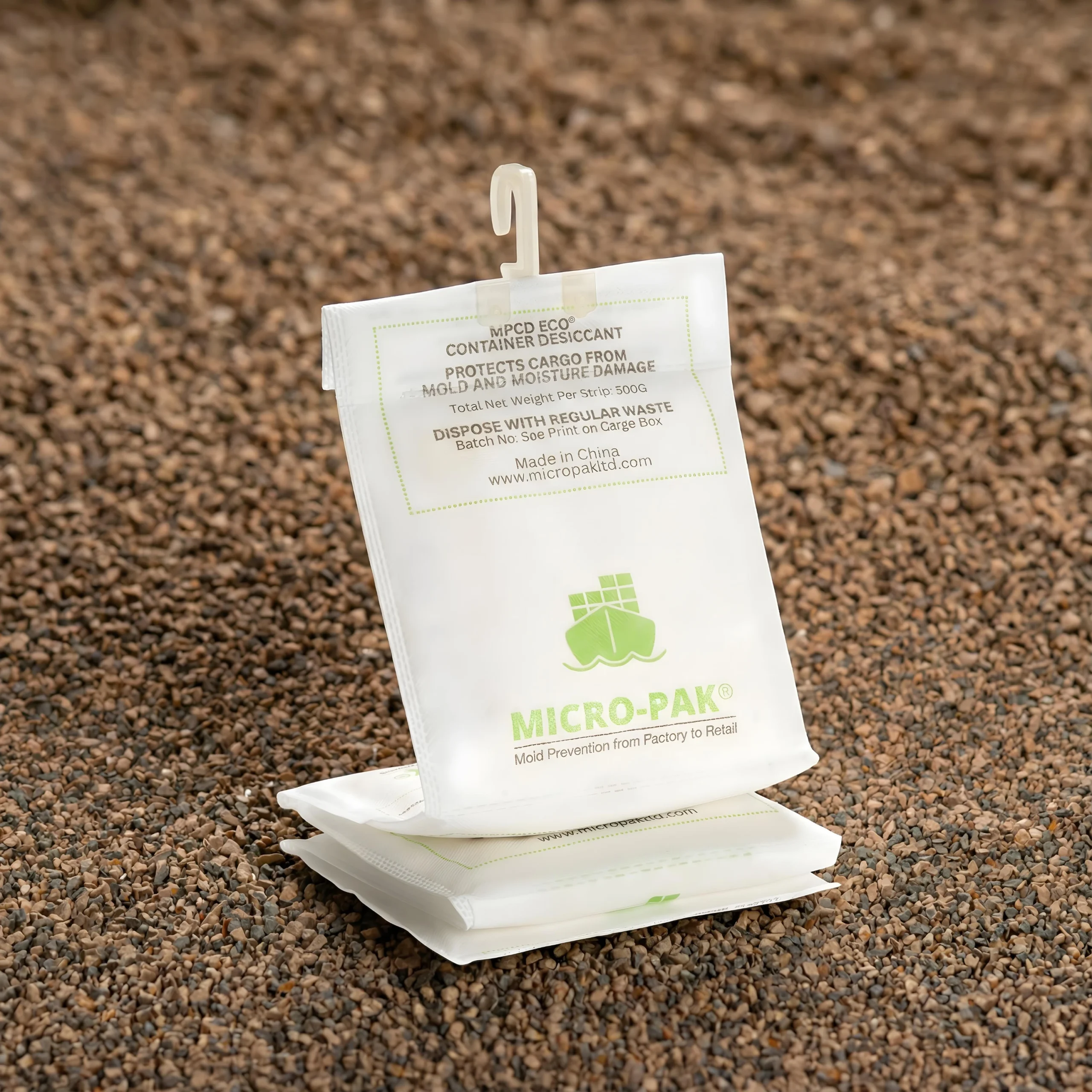
MPCD Eco
What is “cargo sweat”?
Cargo sweat refers to the condensation of water vapor directly on the surface of goods. It occurs when humid air inside a container comes into contact with colder products and reaches its dew point, causing micro-droplets to form on the cargo or its packaging.
This phenomenon is linked to temperature and humidity fluctuations and can occur during both transport and storage, including in temperate climates, whenever day/night temperature differences are present.
MPCD Eco container desiccants help prevent this risk by actively absorbing water vapor from the air, lowering relative humidity and limiting the formation of condensation on the cargo.
What is the dew point inside a container?
The dew point is the temperature at which the air inside a container can no longer retain all the water vapor it contains. When this temperature is reached, moisture condenses and turns into liquid water.
Inside a container, this typically happens when warm, humid air comes into contact with colder surfaces such as the ceiling, metal walls, or cooled goods. The dew point therefore plays a central role in the formation of condensation, cargo sweat, and container rain.
When do we talk about “container sweat” and “container rain”?
Container sweat refers to the condensation of moisture on the internal surfaces of the container, mainly on the ceiling and metal walls, when humid air cools down and reaches its dew point.
When this condensation accumulates, droplets merge and eventually drip onto the cargo. This phenomenon is known as “container rain” and is a major cause of moisture-related damage.
These phenomena can occur during both transport and storage whenever temperature variations, even moderate ones, are present. MPCD Eco desiccants effectively reduce these risks by lowering air humidity and limiting condensation formation inside the container.
Which desiccants are suitable for containers and large volumes?
Transport and storage in containers or large volumes expose goods to significant constraints: long transit times, air exchange, temperature fluctuations, and sometimes harsh climatic conditions. These constraints require desiccants with very high absorption capacity and long-lasting performance.
Traditional clay-based (bentonite) desiccants have limited absorption capacity and are not well suited for large volumes.
MPCD Eco container desiccants, based on calcium chloride, have been designed to meet these requirements. Their very high hygroscopicity allows them to absorb several times their own weight in water vapor and convert it into a gel, providing continuous protection against humidity, condensation, corrosion, and mold.
How should MPCD Eco desiccants be positioned inside a container?
MPCD Eco desiccants should be evenly distributed throughout the container to ensure effective moisture absorption across the entire volume. The number and placement depend on the type of cargo, transit duration, and climatic conditions.
They should be installed as high as possible, ideally suspended from the lashing points, as warm, humid air primarily accumulates near the ceiling, which is the area most exposed to condensation and container rain.
Before installation, the container should be inspected to ensure its integrity and watertightness.
What is Dri Clay® Kraft?
Dri Clay® Kraft is a plastic-free desiccant made from natural bentonite clay and packaged in FSC-certified, biodegradable Kraft paper. It is designed to absorb moisture inside packaging and protect products from humidity-related damage.
The product is Plastic Free certified and presents no risk of leakage, corrosion, or release of harmful substances.